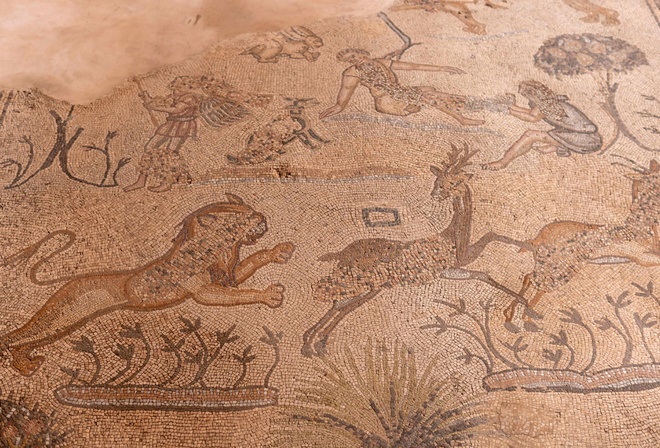
The Byzantine Church of Jabalia in the Gaza Strip, which today is the remains of a Christian church, includes graves and mosaic floors surrounded by marble columns on an area of 850 square meters, including 400 meters paved with mosaics. The church was established in the 5th century and was used until the 8th century.
Location and early history
The church is located northeast of Gaza City, within the municipal boundaries of the city of Jabalia in the North Gaza Governorate, west of the Salah al-Din Road. The church includes a number of inscriptions recording the names of those who contributed to the church. The earliest dates to 444 AD, during the reign of the Byzantine Emperor Theodosius II (408–450)
The Byzantine Church in Jabalia is considered one of the most important churches in the Levant. Since Islam conquered Palestine in 637 AD, the church continued to exist until the Abbasid Islamic era, the era of the Caliph (Abu Jaafar al-Mansur). Christians and churches in the period of Islamic rule in Palestine include 16 ancient Greek texts, and this number cannot be found in any church in the Levant.
The church's decoration contains a large number of geometric and floral decorations, figure paintings, rural scenes, cooking utensils, domestic animals and predatory animals from Palestine and abroad, and various types of tuna. It also includes hunting scenes, rivers, and palm trees, but most of these decorations were destroyed during the iconoclastic war (107–252 AH/726–867 AD), and there were no traces of these decorative elements that could be recovered or repaired.
Discovery and later history
The remains of the church were discovered in 1997 during reconstruction works on the Salah al-Din Road; archaeological investigations followed involving the École Biblique. Yasser Matar and Ayman Hassuneh led the excavations for the Department of Antiquities in Gaza.
The church has been damaged at various points during the Gaza–Israel conflict: in 2003, 2014, and 2021. In 2010, the Ministry of Tourism and Antiquities installed a canopy to protect the mosaic floor from erosion. A restoration project involving international partner organisations began in 2019; it was completed in January 2022 when the church reopened to the public.
In November 2023, a report by Heritage for Peace on the impact on cultural heritage sites of the Israeli invasion of the Gaza Strip included the church as a site that was completely destroyed by shelling. In January 2025, archaeologist Fadel Al Utol reported that while there was debris at the archaeological site that the mosaics were still intact.
Layout
The church was part of a complex of buildings, of which the church was the main element. Attached to it was a diakonikon, and beyond that a baptistry. The church measured 23 by 13 metres (75 by 43 ft) and consisted of a central nave flanked by aisles. The floor was covered by mosaics, the design of which included animal in scenes set in the countryside.
See also
- Blakhiya Byzantine cemetery
References
Further reading
- Reynolds, Daniel (2017). "Rethinking Palestinian Iconoclasm". Dumbarton Oaks Papers. 71: 1–64. ISSN 0070-7546. JSTOR 26497745.
External links
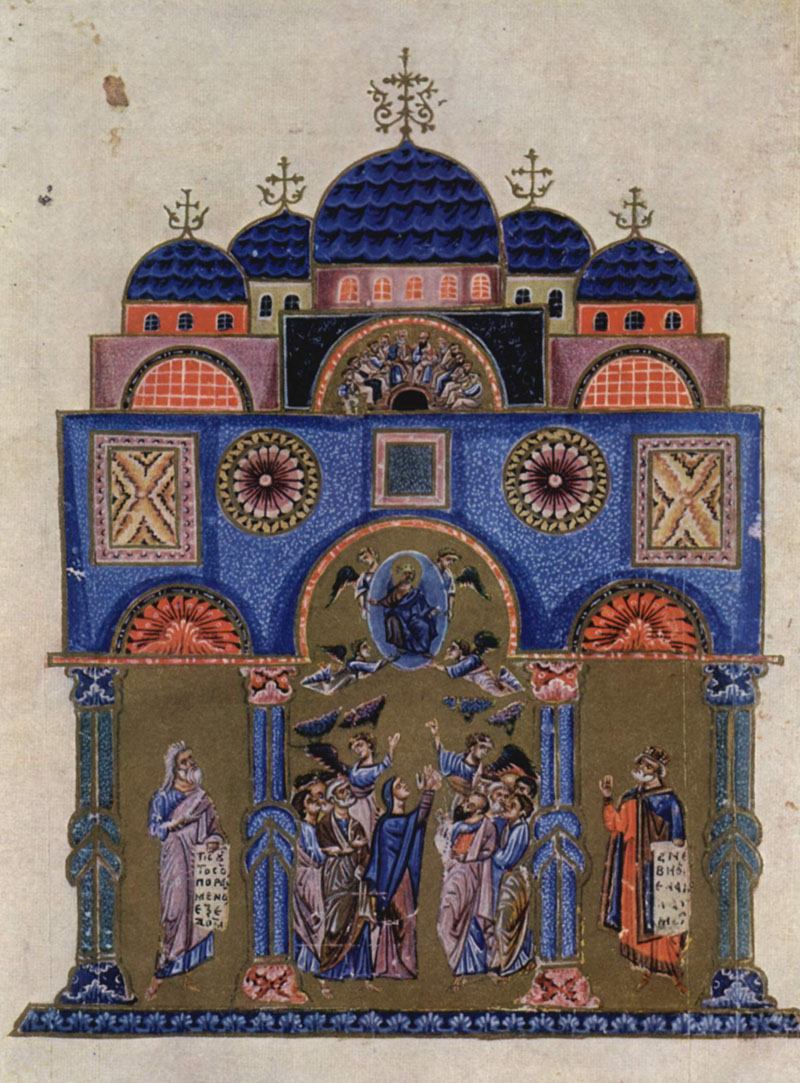
- Reconstruction of how the church may have appeared in the 7th century
- Snaije, Olivia (25 January 2025). "The Past Is Being Destroyed in Palestine — As Well as the Present". New Lines Magazine. Retrieved 22 February 2025.